

1/27/2026
The Delegation of the Parliamentary Assembly of Bosnia and Herzegovina participates in Abu Dhabi in the 2nd Session of the Women Parliamentarians Forum of the Parliamentary Assembly of the Mediterranean
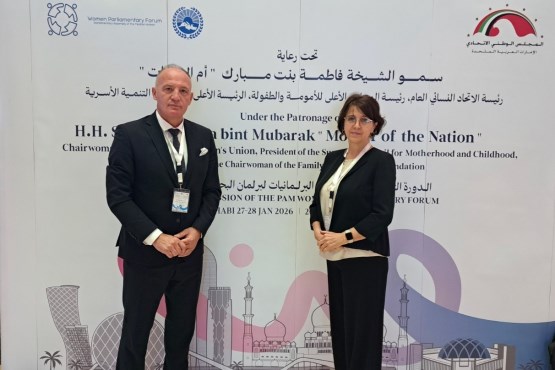
The Chair of the Delegation of the Parliamentary Assembly of Bosnia and Herzegovina (PA BiH) to the Parliamentary Assembly of the Mediterranean (PAM), Ms Rejhana Dervišević, and the Deputy Chair of the Delegation, Mr Vlatko Glavaš, are participating in the 2nd Session of the PAM Women Parliamentarians Forum (WPF), which is being held in Abu Dhabi, organised by the Federal National Council of the United Arab Emirates.
In her address to Forum participants, within the thematic session entitled “Promoting the Empowerment of Women in Political and Economic Life”, Ms Dervišević warned that, even today in the 21st century, women continue to face numerous formal and informal barriers in political and economic life. According to Ms Dervišević, one of the most evident and objective obstacles is the exhausting struggle to achieve a work–life balance. At the same time, she noted, invisible yet powerful barriers lie within deeply rooted social structures, prejudices, and the lack of systemic support. “The insufficient representation of women in positions of power across all spheres of society confirms the existence of these barriers and their resistance to change,” Ms Dervišević stressed, adding that our political and economic systems are still shaped in ways that preserve existing power patterns — patterns in which men predominate.
According to Ms Dervišević, even where gender equality mechanisms and statutory quotas have been introduced, women continue to face discriminatory attitudes, scepticism, and passive resistance on a daily basis. Therefore, she emphasised, in political life the first step must be women’s readiness to step forward — to stand for office, to be visible, and to assume responsibility. At the same time, networking among women in fields traditionally dominated by men would significantly contribute to their stronger positioning and greater influence in decision-making processes.
She underlined that the economic empowerment of women begins — and must begin — with education. “Reskilling, the acquisition of new knowledge, and the concept of lifelong learning are no longer exceptions, but the norm. Therefore, planned and systematic investment in education and professional development programmes is essential, both through formal and non-formal learning. Strong institutional support is also needed to ensure women’s equal access to education, training, and financial resources,” Ms Dervišević stated.
Concluding her address, Ms Dervišević stressed that when women are empowered, society as a whole becomes stronger. “The presence of women and their voices must not be the exception, but the rule. Only in this way can we build a future in which everyone, regardless of gender, has an equal opportunity to influence, create, and lead,” Ms Dervišević said. (End)
|
PRESS
CONTACT |
Public relations department |